


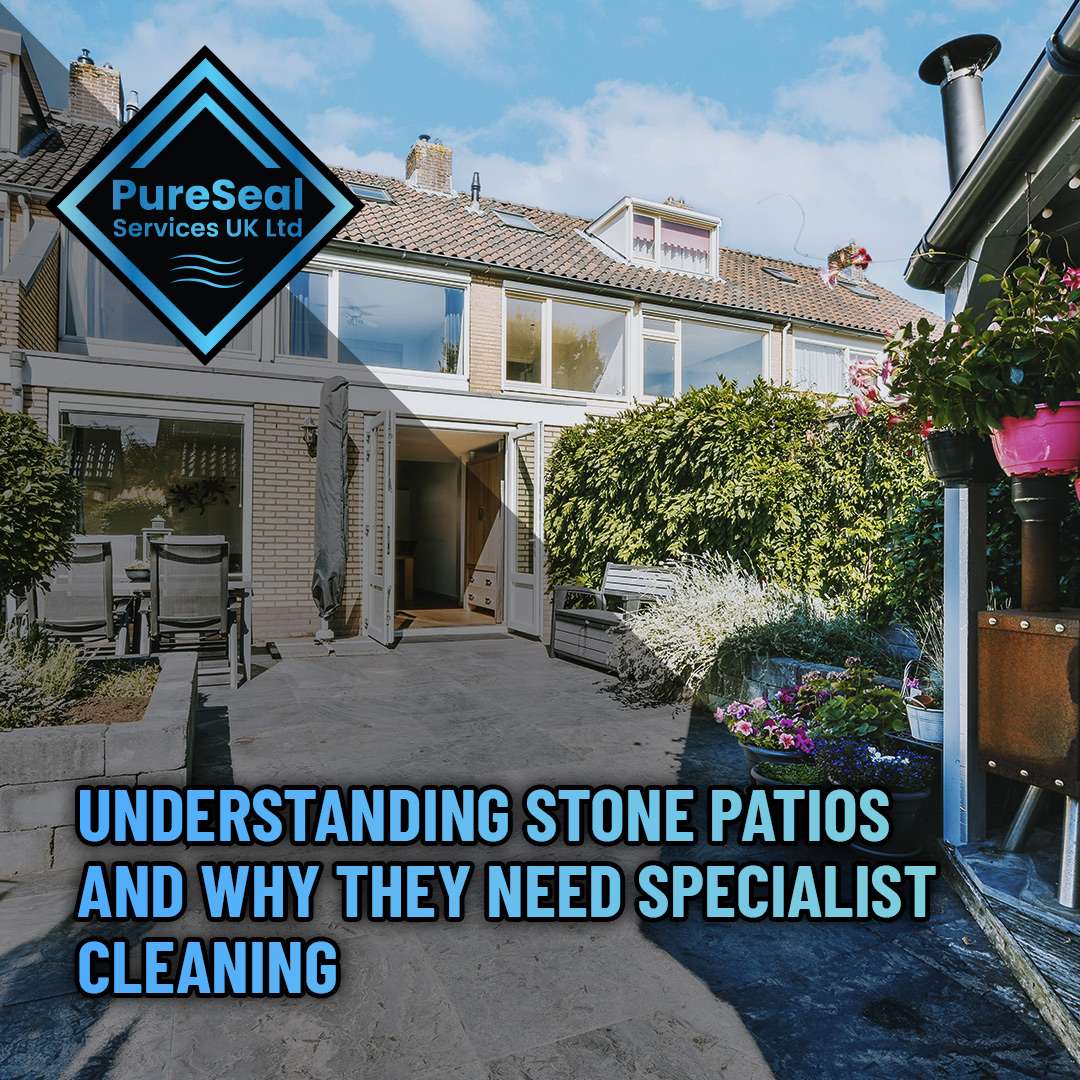
Understanding Stone Patios and Why They Need Specialist Cleaning
Stone patios are a popular feature in UK gardens, valued for their natural appearance, durability, and ability to elevate outdoor living spaces. However, despite their strength, stone surfaces are highly susceptible to staining, algae growth, and general weathering over time. Rain, shade, foot traffic, and organic debris all contribute to a gradual build-up of dirt that can make even the highest-quality patio look tired and uneven.
Unlike artificial paving materials, natural stone is porous to varying degrees. This means it absorbs moisture, oils, and organic matter more easily, which can lead to long-term discolouration if not properly maintained. Cleaning a stone patio is not simply a case of blasting it with water. It requires an understanding of the stone type, its condition, and the correct combination of cleaning methods.
At Pureseal Services, stone patio cleaning is approached as a restoration process rather than a basic wash. The goal is to return the surface to a clean, natural finish while protecting its structure and extending its lifespan.
Types of Stone Used in UK Patios
Before choosing a cleaning method, it is essential to understand the type of stone being treated. Different materials respond in very different ways to moisture, pressure, and chemicals.
Common Stone Patio Materials
| Stone Type | Characteristics | Cleaning Sensitivity |
|---|---|---|
| Sandstone | Porous, natural colour variation | High |
| Limestone | Smooth texture, alkaline composition | Medium-High |
| Slate | Dense, layered structure | Medium |
| Granite | Very hard, low porosity | Low |
| Indian Sandstone | Highly decorative, widely used | High |
Each of these materials requires a slightly different approach to ensure effective cleaning without damage.
Why Stone Patios Become Dirty Over Time
Stone patios are constantly exposed to environmental conditions that contribute to surface deterioration.
Main Causes of Patio Contamination
- Algae growth in damp or shaded areas
- Moss forming in joints and textured surfaces
- Airborne pollution settling into porous stone
- Soil and plant debris from surrounding gardens
- Oil and food stains from outdoor use
- Hard water deposits from rainfall and irrigation
Over time, these elements combine to create a layered build-up that becomes increasingly difficult to remove with basic cleaning methods.
The Risks of Incorrect Patio Cleaning
Improper cleaning methods can cause long-term damage to stone patios, often making them worse than before cleaning.
Common Mistakes and Their Effects
| Mistake | Resulting Damage |
|---|---|
| Excessive pressure washing | Surface erosion and loss of texture |
| Harsh chemicals | Discolouration or chemical burn marks |
| Inconsistent cleaning | Patchy appearance after drying |
| Ignoring stone type | Permanent surface damage |
| Over-wetting joints | Loose or weakened paving structure |
These issues are often irreversible, which is why professional handling is strongly recommended for natural stone surfaces.
The Best Professional Method for Cleaning Stone Patios
The most effective approach to cleaning stone patios is a controlled, multi-stage process that combines assessment, pre-treatment, cleaning, and finishing.
Step 1: Initial Inspection
Every patio should begin with a full surface assessment.
- Identify stone type and condition
- Check for cracks or loose slabs
- Assess level of staining and organic growth
- Determine drainage conditions
This ensures the correct cleaning method is selected before any work begins.
Step 2: Dry Surface Preparation
Before any water is used, the patio is prepared in its dry state.
- Removal of loose debris such as leaves and soil
- Manual clearing of weeds from joints
- Inspection of problem areas requiring pre-treatment
Dry preparation improves cleaning efficiency and prevents debris from spreading during washing.
Step 3: Targeted Pre-Treatment
Pre-treatment is a crucial stage in professional stone patio cleaning.
Types of Pre-Treatment Used
| Problem Type | Treatment Method | Purpose |
|---|---|---|
| Algae | Biocide application | Breaks down organic growth |
| Moss | Fungicidal treatment | Kills root structure |
| Oil stains | Degreasing solution | Lifts embedded grease |
| Black spotting | Specialist cleaner | Removes deep staining |
Allowing sufficient dwell time is essential for these treatments to be effective.
Step 4: Controlled Pressure Washing
Pressure washing is used carefully and strategically rather than aggressively.
- Low to medium pressure settings
- Wide fan nozzles to reduce surface impact
- Even, overlapping passes
- Avoidance of direct joint erosion
The goal is to lift contamination without damaging the stone surface.
Step 5: Steam Cleaning for Delicate Areas
Steam cleaning is often used alongside pressure washing, especially on sensitive or heavily stained areas.
- Ideal for natural stone
- Reduces need for harsh chemicals
- Minimises surface wear
- Effective on embedded algae and grime
This method is particularly effective for older patios where preservation is important.
Step 6: Rinsing and Residue Removal
Once cleaning is complete, the entire surface is thoroughly rinsed.
- Removes loosened dirt and chemical residue
- Ensures even drying
- Prevents patchy finish
Proper rinsing is essential to achieve a uniform appearance once dry.
Step 7: Drying and Final Inspection
Drying time is often underestimated but plays a key role in final results.
| Weather Condition | Drying Time Estimate |
|---|---|
| Warm and dry | 24–48 hours |
| Mild conditions | 48–72 hours |
| Damp or shaded | 72+ hours |
A final inspection ensures all areas have been cleaned consistently.
Equipment Used in Professional Stone Patio Cleaning
High-quality results depend heavily on the equipment used.
Essential Equipment List
| Equipment Type | Function |
|---|---|
| Pressure washer | Removes surface dirt and algae |
| Steam cleaning system | Deep cleaning without damage |
| Surface cleaner head | Ensures even coverage |
| Soft washing system | Applies controlled treatments |
| Hand tools | Weed and joint cleaning |
At Pureseal Services, commercial-grade systems are used to ensure precision and consistency across all stone types.
Cost of Professional Stone Patio Cleaning
Stone patio cleaning varies in price depending on size, condition, and complexity. High-quality services sit at the more premium end of the market due to the level of care and equipment involved.
Typical UK Pricing Overview
| Patio Size (m²) | Cleaning Cost (£) | Deep Restoration (£) |
|---|---|---|
| 10–30 m² | £200 – £450 | £500 – £900 |
| 30–60 m² | £450 – £900 | £900 – £1,800 |
| 60–120 m² | £900 – £1,800 | £1,800 – £3,500 |
Premium pricing reflects:
- Specialist treatment products
- Skilled labour
- Advanced cleaning systems
- Careful handling of natural stone
Factors That Influence Cleaning Difficulty
Not all patios require the same level of treatment.
Key Influencing Factors
| Factor | Impact Level |
|---|---|
| Stone porosity | High |
| Age of patio | High |
| Level of shade | Medium-High |
| Drainage quality | Medium |
| Maintenance history | High |
Poorly maintained patios typically require multiple treatment stages to fully restore.
Algae, Moss, and Lichen Removal in Detail
Organic growth is one of the most common issues affecting stone patios in the UK climate.
Why It Forms So Easily
- Damp weather conditions
- Lack of direct sunlight
- Poor drainage
- Organic debris accumulation
Effective Removal Strategy
- Biocide application to kill spores
- Controlled pressure washing to remove surface growth
- Steam treatment for deep-rooted areas
- Repeat treatment where necessary
This combination ensures both visible growth and underlying spores are addressed.
Preventing Future Patio Contamination
Once a stone patio has been professionally cleaned, preventative measures can help maintain its condition.
Recommended Maintenance Practices
- Regular sweeping to remove debris
- Periodic light washing
- Immediate removal of organic matter
- Keeping surrounding plants trimmed
Optional Protective Treatments
| Treatment Type | Benefit |
|---|---|
| Sealants | Reduces staining and water absorption |
| Biocide protection | Slows algae regrowth |
| Water repellents | Improves drainage behaviour |
These treatments reduce maintenance requirements and help preserve appearance over time.
Seasonal Considerations for Patio Cleaning
Timing has a significant impact on results.
Best Conditions for Cleaning
- Mild temperatures
- Overcast but dry weather
- Low wind conditions
- Stable weather forecast
Seasonal Impact Table
| Season | Suitability | Notes |
|---|---|---|
| Spring | Excellent | Ideal for resetting winter damage |
| Summer | Very good | Fast drying, but risk of quick evaporation |
| Autumn | Good | High organic debris levels |
| Winter | Poor | Cold and moisture slow drying |
Surface Restoration After Cleaning
Once cleaning is complete, some patios may require additional restoration work to fully improve appearance.
Common Restoration Tasks
- Re-sanding joints where needed
- Realigning displaced slabs
- Light re-treatment of stained areas
- Final detailing for uniform finish
These finishing touches ensure the patio looks consistent and professionally restored.
Why Professional Cleaning Delivers Better Results
While DIY methods can improve appearance temporarily, they rarely achieve the depth of clean required for natural stone.
Key Advantages of Professional Cleaning
- Controlled pressure prevents surface damage
- Specialist products target deep staining
- Even cleaning across the entire surface
- Longer-lasting results
- Reduced risk of discolouration or erosion
At Pureseal Services, the focus is on delivering a high-end finish that enhances both appearance and durability, rather than quick surface-level improvements.
Maintaining a Clean Stone Patio Long-Term
Ongoing care is essential to preserve the results of a professional clean.
Long-Term Maintenance Plan
| Frequency | Task |
|---|---|
| Weekly | Sweep debris |
| Monthly | Light rinse |
| Quarterly | Spot treatment |
| Annually | Professional inspection |
Consistent upkeep helps prevent heavy build-up and reduces the need for intensive future cleaning.
Final Surface Performance Expectations
A properly cleaned stone patio should achieve:
- Even colour restoration
- Removal of algae and organic growth
- Clean joints and edges
- No surface damage or erosion
- Improved overall appearance
This level of finish reflects a careful, structured cleaning process designed specifically for natural stone surfaces.
Advanced Problem Areas on Stone Patios and How They’re Treated
Even after a full professional clean, some stone patios present persistent problem areas that require extra attention. These are usually caused by long-term neglect, poor drainage, or repeated organic growth in the same locations. Addressing these properly is what separates a surface that simply looks “cleaned” from one that looks properly restored.
At Pureseal Services, these areas are treated as part of a detailed finishing process rather than an afterthought, ensuring the entire patio has a consistent appearance.
Deep-Set Black Spotting
Black spotting is one of the most stubborn forms of contamination on natural stone, especially sandstone and limestone.
What Causes Black Spots
- Airborne pollution bonding with moisture
- Algae growth embedded into pores
- Iron or mineral deposits in the stone
- Long-term damp conditions with limited sunlight
Treatment Approach
| Stage | Method | Purpose |
|---|---|---|
| 1 | Specialist pre-treatment | Breaks down organic material |
| 2 | Controlled dwell time | Allows penetration into pores |
| 3 | Steam application | Lifts embedded contamination |
| 4 | Rinse and repeat cycles | Ensures full removal |
Black spots often require multiple passes. Rushing this stage can leave faint shadows that become visible again after drying.
Efflorescence on Stone Surfaces
Efflorescence is a white, powdery residue that appears when salts rise to the surface of stone.
Why It Occurs
- Moisture moves through porous stone
- Dissolved salts are carried to the surface
- Evaporation leaves crystalline deposits behind
Treatment Options
- Dry brushing for light deposits
- Controlled rinsing for moderate build-up
- Specialist neutral cleaners for heavy cases
| Severity Level | Appearance | Treatment Intensity |
|---|---|---|
| Light | Faint white haze | Low |
| Moderate | Patchy white deposits | Medium |
| Heavy | Thick crystalline layer | High |
Efflorescence is often recurring if moisture issues are not addressed, so drainage plays an important role in prevention.
Drainage Problems and Their Impact on Cleaning Results
Poor drainage is one of the most overlooked causes of recurring patio staining and algae growth.
How Drainage Affects Stone Patios
- Water pooling encourages moss and algae
- Constant dampness accelerates staining
- Uneven drying creates patchy appearance
- Weakens jointing material over time
Common Drainage Issues
- Blocked or poorly positioned drains
- Incorrect patio gradient
- Compacted soil beneath paving
- Overgrown surrounding vegetation
Drainage Improvement Considerations
| Issue | Impact on Patio | Recommended Action |
|---|---|---|
| Standing water | Algae growth | Regrading or channel clearing |
| Slow runoff | Staining and dampness | Drain cleaning or adjustment |
| Saturated sub-base | Movement of slabs | Structural correction |
Without addressing drainage, even the best cleaning results will not last as long as expected.
Joint Cleaning and Re-Sanding in Stone Patios
The joints between paving slabs play a major role in both appearance and stability. Over time, they collect dirt, weeds, and organic matter, which can affect the overall finish of the patio.
Why Joint Cleaning Matters
- Prevents weed regrowth
- Improves structural stability
- Enhances overall visual uniformity
- Reduces water retention between slabs
Joint Cleaning Process
- Weed and debris removal
- Low-pressure rinsing to clear buildup
- Application of appropriate jointing material
- Compacting for stability
Re-Sanding or Re-Jointing Table
| Joint Condition | Recommended Action | Outcome |
|---|---|---|
| Slight erosion | Top-up sanding | Stabilised joints |
| Moderate loss | Full re-sand | Restored structure |
| Severe damage | Re-jointing required | Full restoration |
Proper joint maintenance ensures that the cleaned surface remains stable and visually consistent over time.
Colour Restoration in Natural Stone
One of the most noticeable changes after professional cleaning is the restoration of the stone’s natural colour. Over time, dirt, algae, and environmental pollutants dull the surface, masking its original appearance.
Why Colour Fades Over Time
- Layered dirt accumulation
- Organic growth coverage
- UV exposure altering surface tone
- Moisture absorption affecting colour depth
Enhancing Natural Stone Appearance
| Technique | Effect on Stone Appearance |
|---|---|
| Steam cleaning | Reveals natural variation |
| Controlled washing | Removes surface dullness |
| Neutral treatments | Restores original tone |
| Careful drying | Prevents patchy appearance |
A properly cleaned stone patio often looks significantly lighter and more defined once restored, as hidden natural patterns become visible again.
Managing Sensitive or Decorative Stone Finishes
Some patios are made from decorative or high-end stone materials that require a more refined approach.
Examples of Sensitive Finishes
- Honed limestone
- Polished sandstone
- Decorative riven slate
- Mixed aggregate designs
Special Handling Requirements
- Reduced pressure levels
- Increased reliance on steam cleaning
- Minimal chemical usage
- Careful attention to surface texture
Even slight over-cleaning can alter the appearance of these surfaces, so precision is essential.
Impact of Foot Traffic Patterns on Cleaning Results
Foot traffic plays a subtle but important role in how stone patios age and how they should be cleaned.
High-Traffic Zones
- Garden entrances
- Patio seating areas
- BBQ or cooking zones
- Walkways between structures
These areas typically require deeper cleaning due to:
- Oil and food spills
- Repeated compaction of dirt
- Faster wear of protective layers
Traffic-Based Cleaning Strategy
| Area Type | Cleaning Intensity |
|---|---|
| Low traffic | Standard cleaning |
| Medium traffic | Enhanced treatment |
| High traffic | Deep restoration |
Understanding traffic patterns helps ensure cleaning effort is focused where it is needed most.
Long-Term Structural Considerations After Cleaning
Cleaning a stone patio is not only about appearance. It also reveals underlying structural conditions that may need attention.
Common Structural Issues Revealed
- Loose or rocking slabs
- Cracked stones
- Failing joint material
- Uneven settling of base layers
Maintenance Priorities After Cleaning
- Repairing unstable slabs
- Re-leveling affected areas
- Replacing damaged stones
- Strengthening joints
Addressing these issues early prevents further deterioration and maintains the integrity of the patio.
Professional Equipment Calibration and Its Importance
The effectiveness of patio cleaning depends heavily on equipment calibration. Even high-end systems can cause damage if not properly adjusted for the surface type.
Key Calibration Factors
- Water pressure settings
- Steam temperature control
- Nozzle type and spray pattern
- Distance from surface during cleaning
Why Calibration Matters
Incorrect settings can lead to:
- Surface etching
- Loss of natural texture
- Uneven cleaning patterns
- Damage to joints or edges
At Pureseal Services, calibration is adjusted for each individual project rather than using a standard setting, ensuring consistent and safe results.
The Role of Experience in Achieving Consistent Results
Stone patio cleaning is not purely technical; it also relies heavily on operator experience. Understanding how different stones react in real time allows for adjustments that protect the surface while still achieving a deep clean.
Experienced-Based Adjustments Include
- Reducing pressure on fragile areas mid-clean
- Switching methods based on surface response
- Identifying hidden contamination layers
- Adjusting dwell times for chemical treatments
This level of judgement cannot be replicated by basic equipment alone.
Final Surface Presentation Standards in High-End Cleaning
Once all cleaning, restoration, and finishing work is complete, the final appearance of the patio should meet a consistent standard.
Expected High-End Results
- Uniform colour across all stone sections
- No visible algae or organic staining
- Clean, well-defined joints
- Restored natural texture without erosion
- Balanced, non-patchy drying finish
A well-executed clean should make the patio look naturally refreshed rather than artificially altered, preserving the character of the stone while improving its overall condition.
Ongoing Performance Expectations After Professional Cleaning
After a full professional clean, a stone patio should perform better in terms of both appearance and maintenance.
Post-Clean Benefits
- Slower regrowth of algae and moss
- Easier routine maintenance
- Reduced staining from organic matter
- Improved water runoff behaviour
- Enhanced visual consistency throughout the year
These improvements are long-lasting when combined with sensible upkeep and periodic maintenance, ensuring the patio continues to look well cared for without requiring constant intensive cleaning.
Final Conclusion on Cleaning Stone Patios the Right Way
Cleaning a stone patio properly is not a single task, but a layered process that combines surface understanding, material knowledge, controlled cleaning methods, and careful finishing. What often looks like a simple outdoor cleaning job is, in reality, a detailed restoration exercise that directly affects both the appearance and longevity of the stone.
The key takeaway is that natural stone behaves very differently from manufactured paving. It is porous, reactive, and highly sensitive to both moisture and cleaning intensity. That means there is no universal approach that works across every patio. Each surface needs to be assessed individually, with methods adapted based on stone type, age, level of contamination, drainage conditions, and exposure to weather. Without this level of consideration, cleaning results tend to be inconsistent, short-lived, or in some cases damaging.
A properly executed clean always begins long before any equipment is switched on. Inspection and preparation set the foundation for everything that follows. Identifying issues such as algae growth, oil staining, black spotting, or efflorescence helps determine the right combination of treatments. Skipping this stage or rushing through it usually leads to surface imbalance, where some areas look clean while others retain visible staining or shadowing.
The actual cleaning process itself is equally dependent on control rather than force. High pressure alone is rarely the correct answer for natural stone. While it can remove surface dirt quickly, it also carries the risk of eroding the stone’s texture, weakening joints, and creating long-term visual inconsistencies. A more refined approach, combining controlled pressure, steam application, and targeted pre-treatment, produces a far more stable and even result.
One of the most important aspects of professional patio cleaning is understanding that removal is only part of the outcome. The goal is not just to eliminate visible dirt or organic growth, but to restore the natural appearance of the stone while preserving its structure. This is where finishing work becomes critical. Issues such as ghost staining, uneven drying, or residue build-up can all undermine the final appearance if not properly addressed. Careful rinsing, neutralisation where needed, and attention to detail during the final inspection ensure the surface is left in a consistent condition.
Drainage and environmental conditions also play a major role in how successful a clean will be in the long term. A patio that repeatedly holds moisture will always be more prone to algae and moss regrowth, regardless of how thoroughly it has been cleaned. Similarly, shaded or poorly ventilated areas naturally retain more organic growth. Understanding these external factors is important because it helps explain why some patios deteriorate faster than others and why maintenance strategies need to be tailored rather than generic.
Another key consideration is the long-term behaviour of the stone itself. Once cleaned, natural stone tends to reveal its original colour and texture more clearly, which can be a significant visual improvement. However, this also means that any inconsistencies in cleaning become more noticeable. Patchy results, uneven pressure marks, or incomplete treatment of stains can stand out more after drying than they did during the cleaning process. This is why consistency across the entire surface is essential, not just in isolated sections.
Professional cleaning also plays an important role in extending the lifespan of a patio. Organic build-up, trapped moisture, and surface contamination can all contribute to gradual degradation if left untreated. By removing these elements correctly, the stone is not only improved visually but also protected from long-term wear. Joint stability is preserved, surface erosion is reduced, and the overall structure remains in better condition for longer.
In high-quality work, the difference is often found in the details that are not immediately visible. Controlled calibration of equipment, correct selection of cleaning agents, careful adjustment of pressure levels, and patience during dwell times all contribute to the final result. These factors are easy to overlook, but they determine whether the clean is superficial or genuinely restorative.
At a professional level, services such as Pureseal Services approach stone patio cleaning as a specialist craft rather than a routine task. The emphasis is on delivering a balanced result where the stone is cleaned thoroughly but also treated with care, ensuring the natural character of the material is preserved rather than stripped away. This approach recognises that every patio is slightly different and requires its own method rather than a fixed formula.
Ultimately, achieving the best possible outcome comes down to respecting the material and working with its natural properties rather than against them. Stone patios are designed to last for many years, but their appearance depends heavily on how they are maintained. With the right combination of assessment, technique, and finishing, even heavily weathered surfaces can be brought back to a clean, natural, and visually balanced condition that reflects the quality of the material beneath.